IPL Prize Money Explained: Team Payouts and Player Awards
Category: Sport | Published: October 12, 2026
IPL Prize Money Explained: Team Payouts and Player Awards
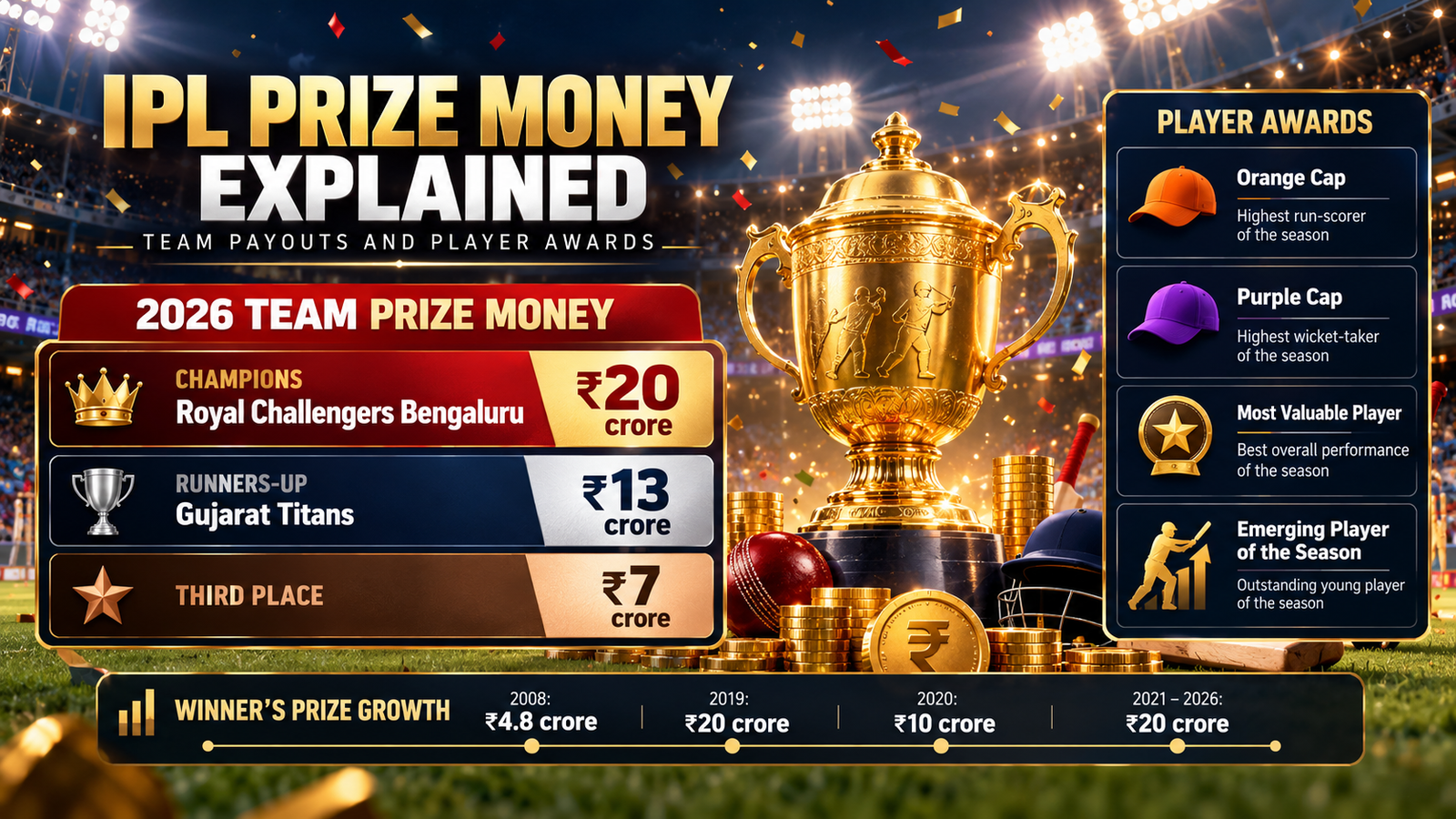
IPL prize money is paid primarily according to a team’s final position, with separate recognition for season-long individual achievements. For the 2026 men’s IPL, the champions, Royal Challengers Bengaluru, received ₹20 crore, while Gujarat Titans, the runners-up, received ₹13 crore. The competition also rewarded the next two playoff finishers and presented honours such as the Orange Cap, Purple Cap, Most Valuable Player and Emerging Player of the Season.The 2026 IPL team prize-money structure
The IPL’s prize distribution gives the largest payout to the side that wins the final, but reaching the playoffs also has clear financial value. According to Wikipedia’s IPL summary, the 2026 champions received ₹20 crore, the runners-up received ₹13 crore, and the third-placed team received ₹7 crore. Royal Challengers Bengaluru won the 2026 title, their second IPL championship, after defeating Gujarat Titans in the final. Finishing position What the result means 2026 prize money Champions Winners of the IPL final ₹20 crore Runners-up Losing finalists ₹13 crore Third place Team finishing third in the playoffs ₹7 crore These headline figures refer to team prizes rather than payments automatically handed to one player. That distinction is important because IPL finances also include player contracts, match-related payments and franchise arrangements. A title-winning cheque reflects a team’s tournament achievement; it should not be read as the salary of the captain, a star player or every squad member.Why the winner receives so much more
The IPL is a Twenty20 competition organised by the BCCI and has used a league stage followed by playoffs. That structure makes the final the defining match of the season, so the gap between first and second is substantial. In 2026, the difference between the champion’s ₹20 crore and the runner-up’s ₹13 crore was ₹7 crore. A runner-up result remains a major achievement, especially after navigating the league phase and knockout rounds, but the larger champions’ payment reinforces the value placed on lifting the trophy. The third-place reward also recognises a strong playoff campaign, even though that team did not reach the final. It gives the knockout stage financial consequences beyond the two finalists.Playoff rewards are not the same as league-table revenue
Prize money is only one part of the financial picture surrounding an IPL season. A team can have a successful league phase, attract strong crowds or build a high-profile squad without winning a central tournament prize. Conversely, a side that reaches the playoffs can earn a finishing-position reward even if its league-stage form was less dominant than that of another team. For readers comparing teams, it helps to separate three ideas: performance in the points table, progress through the playoffs and final prize-money position. The latter is determined by where the team finished in the competition, not simply by league wins. This is why the final stages carry both sporting and financial significance. When assessing form during a season, phrases such as today match prediction 100 sure should be treated separately from confirmed tournament outcomes. A prediction is an opinion about a future match, whereas prize money is determined only after the relevant match or season result is completed.The individual awards that accompany team prizes
The IPL also honours individual performers across a season. The Orange Cap goes to the leading run-scorer, while the Purple Cap recognises the leading wicket-taker. The Most Valuable Player award identifies the season’s standout all-round contribution, and the Emerging Player of the Season award is intended to recognise a young or developing performer. These honours matter because they tell a different story from the team table. The leading run-scorer may not play for the champions, and the leading wicket-taker may represent a team eliminated before the final. Individual awards therefore give supporters a way to recognise consistency over an entire campaign rather than only success in the final match. Published reports have listed cash components for these awards, but the available figures are not fully consistent across reports or currencies. It is therefore safer to distinguish the awards themselves from any unverified prize amount. The official winner of each award and the event’s closing presentation establish the sporting honour; reported cash values should be treated carefully unless they are confirmed in the season’s formal prize announcement.Orange Cap and Purple Cap: performance across a full season
The Orange Cap and Purple Cap are especially visible because their leaders can change frequently during the league stage. The Orange Cap rewards cumulative runs, which places a premium on availability, sustained form and the ability to score in varied match situations. The Purple Cap similarly rewards the highest wicket tally, highlighting bowlers who repeatedly make breakthroughs. Neither cap is a simple verdict on who played the most spectacular innings or delivered the best single spell. A batter could produce one extraordinary century without leading the season’s run chart, while a bowler might take a five-wicket haul but finish behind another bowler on total wickets. The awards reward season-long output, and that makes them useful markers of consistency.Most Valuable Player and Emerging Player awards
The Most Valuable Player award has a broader purpose than the caps. It can recognise a player whose batting, bowling, fielding or combination of contributions had an exceptional overall impact. Because different roles influence T20 matches in different ways, this award captures achievements that cannot be reduced to runs or wickets alone. The Emerging Player of the Season award has a different emphasis. Rather than measuring only established excellence, it draws attention to a player making a notable breakthrough. Recognition at this stage can be significant for a young cricketer’s profile, particularly in a league where players share dressing rooms with experienced Indian and overseas professionals. The honour complements the tournament’s focus on immediate results by acknowledging future potential.A brief look at how IPL winner rewards changed
The winner’s prize has grown markedly since the IPL began in 2008. The 2008 champions, Rajasthan Royals, received ₹4.8 crore, while the 2026 champions received ₹20 crore. That change illustrates how the tournament’s top reward developed over its first 19 seasons. The rise was not perfectly uniform. The winner’s payment reached ₹10 crore in 2010, ₹15 crore in 2013 and ₹20 crore in 2019. In 2020, when the season was held in the United Arab Emirates during the COVID-19 pandemic, the winner’s prize was reduced to ₹10 crore. It returned to ₹20 crore in 2021 and remained at that level through 2026.How to read prize-money headlines accurately
Prize-money headlines can be misleading when they do not specify whether they refer to a franchise, a player, a single award or a tournament-wide pool. The most useful first question is simple: who is receiving the amount? A ₹20 crore champions’ prize belongs to the winning team’s result, while an individual honour recognises a particular player’s performance. It is also sensible to check the season. IPL amounts have changed over time, and an older figure may no longer describe the current structure. The 2020 reduction is a clear example of why historical comparisons need context. A year, competition stage and recipient should always accompany any IPL prize-money figure. Readers looking ahead to upcoming fixtures can use a cricket match prediction site for forward-looking analysis, but confirmed prize figures should always come from the official season announcement.Conclusion
IPL prize money rewards both collective success and individual excellence, but the categories should not be confused. In 2026, Royal Challengers Bengaluru earned ₹20 crore as champions and Gujarat Titans received ₹13 crore as runners-up, while the IPL’s individual awards recognised leading performers across the season.