Highest-Paid IPL Players: 2026 Auction Top 10 Salaries
Category: Sport | Published: October 12, 2026
Highest-Paid IPL Players: 2026 Auction Top 10 Salaries
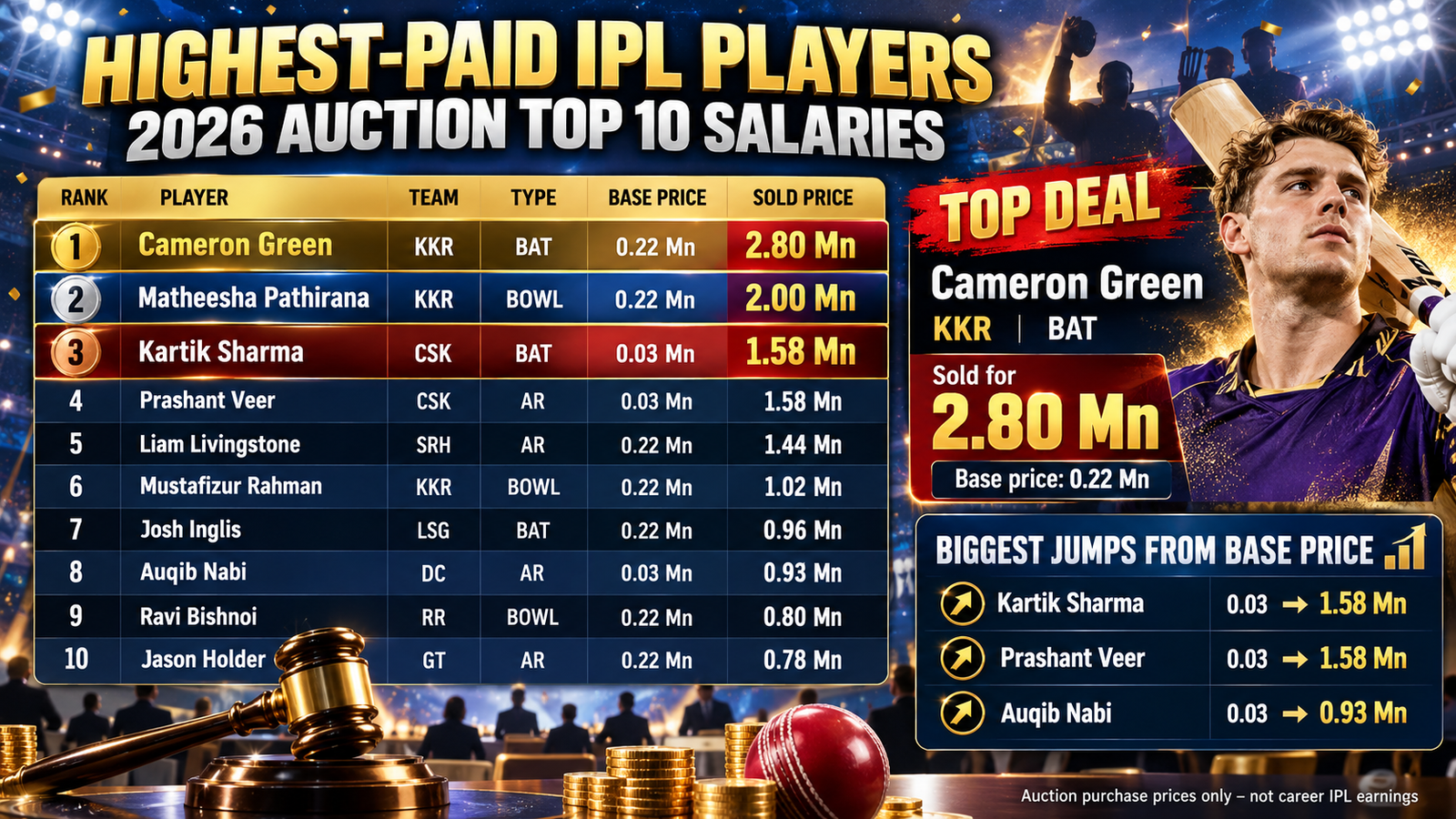
The highest-paid IPL players in the 2026 auction were led by Cameron Green, whose 2.80 Mn deal with Kolkata Knight Riders was the largest bid. Matheesha Pathirana followed at 2.00 Mn, also joining Kolkata Knight Riders, while Chennai Super Kings secured Kartik Sharma and Prashant Veer for 1.58 Mn each. These figures refer specifically to auction purchase prices, not a player’s total IPL earnings across multiple seasons.IPL 2026 auction: the top 10 player salaries
According to ESPNcricinfo’s IPL 2026 Auction top-buys list, the 10 largest purchases covered a broad mix of batting, bowling and all-round talent. Kolkata Knight Riders made three of the six biggest purchases, while Chennai Super Kings had two players inside the top four. The list also shows that a high price was not restricted to established international names: two players with a listed base price of 0.03 Mn reached 1.58 Mn. Rank Player Team Type Base price Sold price 1 Cameron Green KKR BAT 0.22 Mn 2.80 Mn 2 Matheesha Pathirana KKR BOWL 0.22 Mn 2.00 Mn 3 Kartik Sharma CSK BAT 0.03 Mn 1.58 Mn 4 Prashant Veer CSK AR 0.03 Mn 1.58 Mn 5 Liam Livingstone SRH AR 0.22 Mn 1.44 Mn 6 Mustafizur Rahman KKR BOWL 0.22 Mn 1.02 Mn 7 Josh Inglis LSG BAT 0.22 Mn 0.96 Mn 8 Auqib Nabi DC AR 0.03 Mn 0.93 Mn 9 Ravi Bishnoi RR BOWL 0.22 Mn 0.80 Mn 10 Jason Holder GT AR 0.22 Mn 0.78 Mn The table is a snapshot of the IPL 2026 Auction only. It should not be confused with a career-pay ranking, because a player’s cumulative earnings reflect contracts and retentions over many seasons. An auction list answers a more immediate question: which franchises were prepared to spend the most for a player entering this particular season.Why Cameron Green topped the auction list
Green’s 2.80 Mn price was 2.58 Mn above his listed 0.22 Mn base price, the largest sale price and the largest premium among the 10 leading purchases. Listed as a batter in the auction data, he nevertheless represented the most expensive acquisition of the event. Kolkata Knight Riders also bought Pathirana and Mustafizur Rahman, creating a conspicuous cluster of high-value additions among the auction’s leading deals. A player’s listed category is useful for reading the auction results, but it does not capture every reason behind a bid. Teams build squads rather than isolated playing XIs. They may be filling a vacancy, strengthening a particular phase of an innings, adding depth to the bench, or seeking tactical flexibility. Therefore, the final amount is better understood as a reflection of franchise demand at that auction than as a definitive rating of overall cricketing ability.The biggest jumps from base price
The base price establishes where bidding begins; the sold price records where it ended. The difference between the two can reveal which names attracted the strongest competition. Kartik Sharma and Prashant Veer started at 0.03 Mn and both finished at 1.58 Mn, a rise of 1.55 Mn each. Their final price placed them third and fourth overall despite their much lower starting point. Auqib Nabi produced another notable increase, moving from a 0.03 Mn base to 0.93 Mn with Delhi Capitals. By contrast, several established names began at 0.22 Mn. Pathirana rose by 1.78 Mn, Livingstone by 1.22 Mn, Mustafizur by 0.80 Mn and Josh Inglis by 0.74 Mn. The varying gaps show why base price alone cannot predict the final order. For readers tracking squad composition and likely combinations, auction data is only one part of the picture. Player roles, team balance and match conditions matter when examining a prospective XI, which is why many followers also use a dream11 prediction as a starting point for comparing options across batting, bowling and all-round departments.How auction prices take shape
The 2026 top-buys list demonstrates the direct relationship between a player’s base price and the final sale price: every player begins from the listed base and can command more when franchise interest continues. However, the final amount is not simply a reward for reputation. It is the outcome of how many teams value that player’s role within their own squad plans at the same time. Role scarcity can be especially important. Among the top 10, there were three players listed as batters, three as bowlers and four as all-rounders. The presence of all three categories near the top suggests that franchises were not pursuing only one type of player. Rather, bids were spread across different needs: batting resources, specialist bowling options and multi-skill players who offer additional balance. The top 10 also featured players across six franchises. Kolkata Knight Riders had three, Chennai Super Kings had two, and Sunrisers Hyderabad, Lucknow Super Giants, Delhi Capitals, Rajasthan Royals and Gujarat Titans had one each. This distribution matters because auction prices are created by competing requirements. A player becomes especially valuable when multiple squads identify the same gap and see that individual as a suitable answer.Base price is a starting point, not a ceiling
The contrast between the 0.03 Mn starters and the 0.22 Mn starters is one of the clearest features of the auction. Kartik Sharma, Prashant Veer and Auqib Nabi began at the lower listed base but all entered the top 10. That does not mean a lower base automatically leads to a bigger bargain or a higher final bid. It means the market response on the day can alter the expected hierarchy sharply. Meanwhile, Jason Holder’s 0.78 Mn purchase by Gujarat Titans was only 0.56 Mn above his 0.22 Mn base, while Ravi Bishnoi’s 0.80 Mn deal with Rajasthan Royals was 0.58 Mn above the same base. Both still ranked among the 10 largest purchases. Auction outcomes should therefore be read in two ways: by final price and by the premium above the starting price.Team needs influence competition
The team beside a player’s name is as important as the fee itself. Kolkata Knight Riders’ purchases of Green, Pathirana and Mustafizur Rahman accounted for the first, second and sixth-largest deals. Chennai Super Kings’ twin 1.58 Mn purchases of Sharma and Veer made them the only other side with two players in the top four. This does not prove exactly why each franchise bid, as auction figures do not reveal internal strategy. It does show that teams can concentrate spending on a few major acquisitions rather than spreading it evenly across every position. A single auction can therefore reshape a squad’s priorities, especially when several high-price buys arrive at one franchise.Auction salary versus career IPL earnings
“Highest-paid IPL player” can mean different things. In auction discussion, it usually means the largest price paid for a player in that event. In career discussions, it can mean total earnings accumulated from contracts over many IPL seasons. These are different measures and should not be combined in one ranking. A player who topped an auction may not lead all-time earnings, while a long-serving player with repeated contracts can rank highly in cumulative pay without holding that season’s top bid. The IPL 2026 Auction list is most useful when viewed as a record of one marketplace at one point in time, with each franchise responding to its immediate requirements. For wider IPL coverage beyond the auction table, readers can visit Winmatch365. The 2026 auction’s largest salaries underline the competitive nature of IPL squad building. Green led the way at 2.80 Mn, but the sharp rises for Sharma, Veer and Nabi also showed how quickly bidding can transform a modest base price into one of the event’s defining deals.